
What Does a Strategic Executive Assistant Actually Do?
March 30, 2026
If you've ever been told you're "just an EA," this one's for you.
You manage your executive's calendar, inbox, travel, and a hundred moving parts that nobody else even notices. You keep the wheels turning. And yet, when people hear "Executive Assistant," they still picture someone who books flights and makes coffee.
Here's the truth. The most effective Executive Assistants don't just manage tasks - they shape outcomes. They don't just support their executive - they multiply their executive's impact.
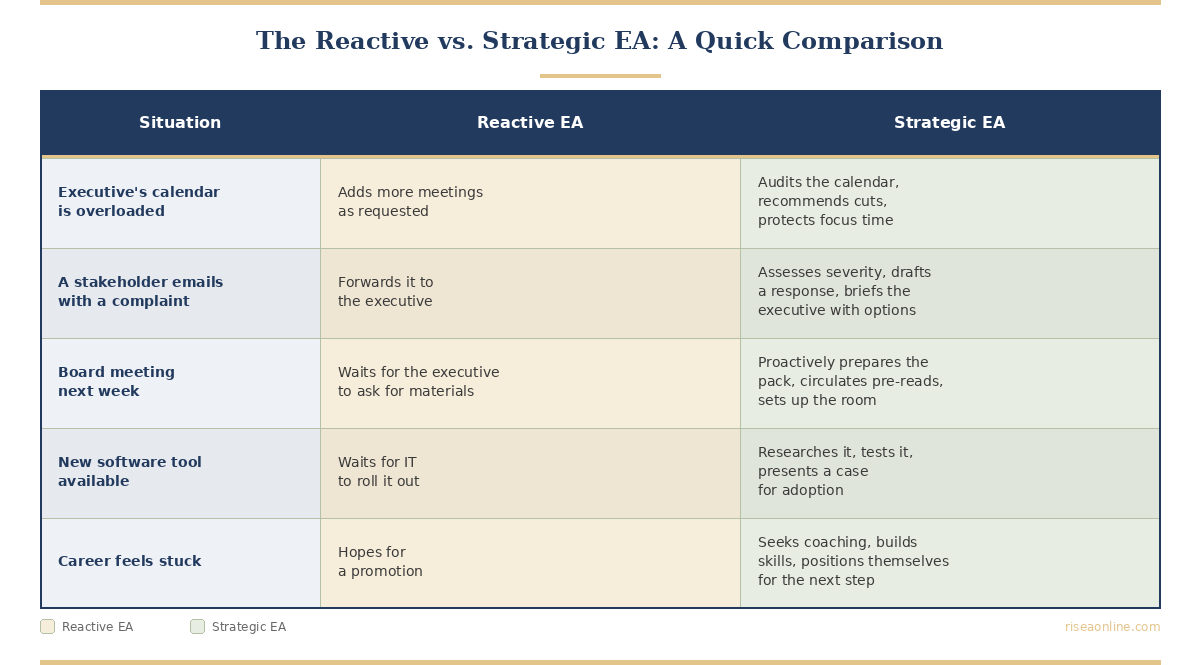
That shift - from reactive support to strategic partnership - is what separates a good EA from an indispensable one. And it's a shift you can make deliberately.
After 20+ years supporting C-suite executives across healthcare, property, hospitality, construction, and recruitment, I've seen firsthand what this transformation looks like.
Let me break it down.
The Old Definition vs. The New Reality
Traditionally, the EA role was defined by tasks. Scheduling meetings. Booking travel. Managing correspondence. Taking minutes. Filing and organising.
These are still part of the job. But they're the floor, not the ceiling.
Today's most valued Executive Assistants operate as strategic partners - trusted advisors who anticipate needs, influence priorities, and protect their executive's most valuable resource: their time and attention.
The difference isn't about doing more. It's about thinking differently.
6 Things a Strategic Executive Assistant Actually Does
1. They Anticipate - Not Just React
A reactive EA waits to be told what to do. A strategic EA sees what's coming before it arrives.
This means reviewing the week ahead on Friday and flagging conflicts or preparation gaps.
It means noticing when a recurring meeting has lost its purpose and suggesting a restructure.
It means preparing briefing notes for a stakeholder meeting before being asked.
The mindset shift is simple but significant. Move from "What do you need?" to "Here's what I've already handled."
2. They Manage Up - With Confidence
Managing up isn't about telling your executive what to do. It's about protecting their focus and making them more effective. Strategic EAs
Push back on low priority meeting requests - diplomatically.
They guard deep focus time on the calendar.
They surface the information their executive actually needs rather than everything that lands in the inbox.
They know when to escalate and when to handle something themselves.
This requires trust. And trust is built by consistently demonstrating good judgement.
3. They Build Systems - Not Just Follow Processes
Anyone can follow a process. A strategic EA builds the process. This looks like
Creating SOPs for recurring workflows - board meeting prep, travel booking, onboarding.
Implementing tools that save hours.
Continuously improving how things get done rather than just doing them the same way every time.
A simple rule worth adopting: if you're doing the same task more than three times, document it. Then automate or delegate it.
4. They Communicate at an Executive Level
Strategic EAs are often the bridge between their executive and the rest of the organisation. That means your communication - written and verbal - needs to match the room you're operating in.
This includes:
Drafting communications that sound like your executive.
Running meetings confidently when they're unavailable.
Navigating sensitive conversations with diplomacy and discretion.
Knowing the difference between what needs to be said and what needs to be left unsaid.
5. They Understand the Business - Not Just the Calendar
You can't be strategic about something you don't understand. The best EAs invest time in learning:
How the business makes money
Who the key stakeholders are and what they care about.
What's happening in the industry.
What keeps their executive up at night.
When you understand the business context, you stop being someone who schedules a board meeting and start being someone who ensures the board pack is complete, the right pre-reads are circulated, and the follow-up actions are tracked.
6. They Invest in Their Own Growth
Nobody is coming to develop your career for you. Strategic EAs take ownership of their professional development.
They seek out coaching and mentorship - not just training.
They build networks with other EAs who challenge and inspire them.
They stay current with tools, especially AI, that can amplify their impact.
They set career goals that go beyond simply maintaining the status quo.
So How Do You Make the Shift?
If you're reading this and thinking I want to be that strategic EA - that awareness is step one.
Start by auditing your current week. How much time is spent on reactive tasks versus proactive, strategic work? Even a 10% shift makes a difference.
Then pick one system to build. Choose the most repetitive part of your week and create a template or process for it.
Have the conversation with your executive. Tell them you want to operate more strategically. Most leaders will welcome it - they just need to know you're ready.
And get support. A coach who has been in the EA seat can help you see blind spots, build confidence, and create a roadmap that actually fits your role and your goals.
Ready to Rise from Support to Strategic Partner?
At RiseA, I coach Executive Assistants through this exact transition. Whether you're building your foundation in the early years or you're a senior EA ready to operate at the highest strategic level, my 6-month programs give you the systems, confidence, and roadmap to get there.
Because you were never "just an EA." It's time your career reflected that. 🌿
Emma Hyatt is the founder of RiseA and has over 20 years of experience supporting C-suite executives, Boards, and Senior Leaders across healthcare, hospitality, construction, property, and recruitment. She coaches Executive Assistants to move from reactive support to strategic partnership.